
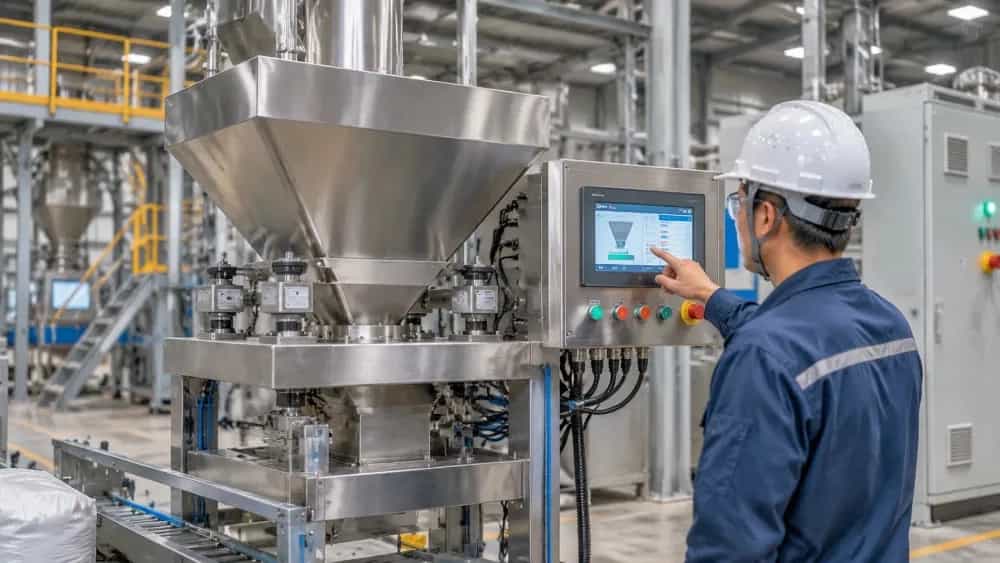
Smarting the industrial weighing system does not always mean a complete replacement of the scale, tank or mechanical structure. If the load cells, junction box and material transfer mechanism are healthy and suitable for the process, the existing system can be converted from a simple weight display tool to a part of the production control process by choosing a compatible formula reader display.
The decisive point is not the number of features written in the catalog; The display must be compatible with the load cell, scale capacity, material entry method, controllable equipment and line automation level.
What is the difference between the formula reading display and the normal weight display?
A typical display receives the electrical signal from the load cell and converts it into a readable weight value. More advanced displays and controllers can provide weight data to the control system and participate in processes such as filling, batching and formulation based on a defined program.
On a formula reader display, the operator can select a specific formula or build command. Each formula may include material name, target weight or percentage, entry order, time delay, and equipment-related commands. Some systems allow for manual, semi-automatic or automatic batch execution; But the existence and level of these capabilities are completely dependent on the display model and its program.
So, being a formula reader isn't just about memorizing some numbers. The real value is created when the display can guide the weighing process, detect the achievement of the target weight and send the appropriate command to the next equipment.
The main components of an intelligent weighing system
Load cell and mechanical section
The load cell converts the force caused by the weight into an electrical signal. The display processes this signal and displays the weight or provides it to the control system.
Before equipping industrial scales, the capacity, number, sensitivity and connection method of load cells should be checked. Improper mechanical installation, jamming of the tank against the surrounding structure, vibration transmission or faulty cabling cannot be corrected by simply replacing the display.
Inputs, outputs and setpoints
To control a valve, motor, conveyor, vibrator or alarm, the display needs a corresponding output. Digital inputs can also receive the status of keys, sensors or permission to start operations.
In a multi-material process, the number of outputs must be compared to the actual architecture of the line. If the equipment is controlled via PLC, the display may only convey the weight value; But in a stand-alone system, the display itself must implement more logic.
Communication with PLC, HMI or software
Communication support such as RS-485 and protocols such as Modbus can enable data exchange between the display, PLC or HMI. Some industrial equipment in the market also use the same structure to connect to the control system.
Merely having a communication port is not enough. The type of protocol, the structure of registers, the speed of communication and the possibility of reading statuses and errors must be specified before purchase.
Selection criteria for formula reader display
Decision criteria | Essential question before purchase |
Load cell compatibility | Does the display have the capacity to feed and receive the signal of the existing load cells? |
Formula capacity | How many formulas, ingredients and steps should be stored? |
Method Batching | Is the formula based on fixed weight, percentage or cumulative weight? |
Level of automation | Manual, semi-automated or fully automated operation Is it? |
Input and output | How many valves, motors, sensors or alarms should be controlled? |
Industrial communication | Connection to PLC, HMI, printer or software is required? |
Environmental conditions | Is the board exposed to dust, moisture, vibration or temperature change? |
Future Development | Adding a new ingredient, formula, or feature anticipated? |
Batching displays may support different formula definition methods, including fixed weight, percentage, or cumulative gross weight. This difference directly affects the control logic and how the operator works.
Common mistakes in the intelligentization of the industrial weighing system
Purchasing the monitor before checking the process: First, the sequence of entering the materials, the number of steps, the required accuracy and the way of commanding the equipment must be determined.
Focusing only on nominal accuracy: In addition to the display, process repeatability depends on the condition of the load cell, mechanical installation, material input speed and timely interruption of flow.
Ignore excess weight after the steering is disconnected: After the valve is closed or the tape is stopped, some material may still enter the tank. Control design must take into account this actual line behavior.
Not estimating future development: A display that only covers current needs may limit when adding material or connecting to a PLC.
When does it make sense to upgrade an existing system?
Upgrading is a good option when the mechanical part and load cells are usable, but the current system only displays weight or formula control depends on constant operator intervention. On the other hand, if the load cells are defective, the capacity of the scale is inappropriate, or the structure is under tension and mechanical jamming, the foundation problem must be solved first.
To choose a solution in Tehran or other cities, visiting or getting detailed information about the panel, load cell, controllable equipment and production process is more reliable than guessing the right model.
Summary and action guide
To smarten industrial weighing system with formula reader display, first document the process: number of materials, weight of each step, sequence of operations, controllable equipment and communication requirement. Then measure the compatibility of the display with the existing load cell and panel.
Tawzinsaz Industries, under the management of Mehdi Nazarinejad, has announced reasonable prices, unlimited technical support and the possibility of updating or adding new features during the contract without charging additional fees as the advantages of its services. The exact details of each feature should be recorded according to the contract and the technical structure of the project.
تماس با ما